
Do you need a visa to study English in Malta? It depends on just two things: your passport and how long your course lasts. In this guide, we explain the rules in simple words, step by step, so you know exactly what to do before you book.
One important note: visa rules can change, and the final decision is always made by the Maltese authorities. Always check the official Identità pages, and talk to our team if you have questions about your case.
Important: before you apply or travel, always check the current legal rules on the official portals of the Government of Malta, including Identità (identita.gov.mt) and the Ministry for Foreign Affairs (foreignaffairs.gov.mt). This guide is for general information only and does not replace official advice.
The quick answer
- EU, EEA and Swiss citizens: you do not need a visa to study English in Malta.
- Visa-exempt countries and a course of 90 days or less: you usually do not need a visa. This includes Mexico, Colombia, Brazil, Argentina, Chile, Peru, the United States, Canada, Japan and South Korea, among others.
- Other countries and a course of 90 days or less: you usually need a Schengen short-stay visa (C visa).
- Any non-EU country and a course longer than 90 days: you usually need a national long-stay visa (D visa), even if your country is visa-exempt for short trips.
Step 1: Check your passport
EU, EEA and Swiss citizens
You can come to Malta with your passport or national ID card and study for as long as you want. If you stay longer than three months, you may need to register your stay with Identità, Malta’s agency for residence documents.
Visa-exempt countries
Many countries can enter the Schengen area, including Malta, without a visa for up to 90 days in any 180-day period. In Latin America, this includes Argentina, Brazil, Chile, Colombia, Costa Rica, El Salvador, Guatemala, Honduras, Mexico, Nicaragua, Panama, Paraguay, Peru, Uruguay and Venezuela.
Good to know: the EU is preparing ETIAS, a new online travel authorisation for visa-exempt visitors. It is not running yet and there is no official start date, so check the official ETIAS website before you travel.
Countries that need a visa even for short stays
Some nationalities need a visa for any stay in Malta, even a one-week course. Examples include Bolivia, Cuba, the Dominican Republic, Ecuador, India, China, Morocco and Turkey. If this is your case, you must get your visa before you travel.
Step 2: Check how long your course is
Courses of 90 days or less
If you are visa-exempt, you can usually come without a visa. If you need a visa, you apply for a Schengen short-stay visa (C visa). It normally covers your whole course plus a few extra days, up to a maximum of 90 days. Full details are on the official Identità page for courses up to 90 days.
Courses longer than 90 days
For longer courses, non-EU students usually need a national long-stay visa (D visa), which can cover up to 365 days. This applies even if your country does not need a visa for short trips. You must apply before you travel, through Malta’s authorised visa service centres. Full details are on the official Identità page for courses over 90 days.
Staying longer than one year
If your studies continue after your visa ends, you need to ask Identità for permission to stay longer. You must do this not more than 30 days and not less than 21 days before your visa expires, and show proof of good attendance and progress at school.
Documents you usually need
The exact list depends on your visa type and your country, but most students need:
- A valid passport that is valid for at least three months after your stay.
- The visa application form, signed, and recent passport photos.
- A letter of acceptance from a licensed English school in Malta.
- Proof of accommodation in Malta for your whole stay.
- Travel medical insurance valid in the Schengen area, with cover of at least €30,000.
- A return ticket or proof of how you will leave Malta.
- Proof that you have enough money for your stay.
- Your biometric data (fingerprints and photo), taken when you apply.
How long does it take and how much does it cost?
- Short-stay visa (C visa): the standard fee is €90 for adults. Apply at least four weeks before you travel.
- Long-stay visa (D visa): applications go through the authorised visa service centre. Processing usually takes four to eight weeks, so apply at least eight weeks before your course starts.
- Extra service fees may apply at the visa centre. Check the current costs on the official pages, as they can change.
Our tip: do not buy a non-refundable flight until your visa is approved.
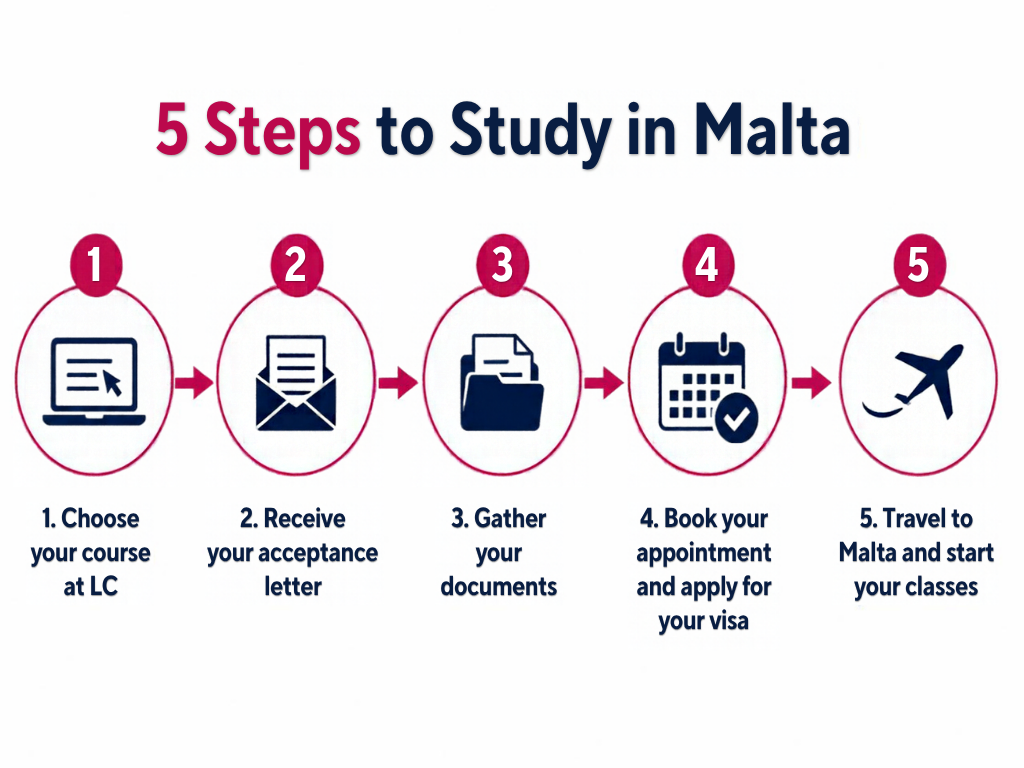
Tips for a smooth application
- Start early. Most problems come from applying too late.
- Choose a licensed school. Make sure your school is licensed by the ELT Council, Malta’s authority for English schools.
- Book your accommodation with the school. It makes your proof of accommodation simple and clear.
- Keep your documents consistent. Names, dates and addresses should match in every document.
- Go to class. If you want to extend your stay later, your attendance and progress really matter.
How Language Connect helps
- We are a licensed school. Language Connect is licensed by Malta’s ELT Council.
- Clear documents. After you book, we send you the documents from the school that you need for your application.
- Accommodation you can prove. Stay at our LC School Residence or our shared apartments, close to school. See our accommodation options.
- Long stays made simple. Our Long-Term Study programme includes progress tests every four weeks, which helps when you need to show good progress.
- A real team that answers. Message us on WhatsApp and we will explain the next steps for your nationality and course.
- Easy to find. Our school is at First Door, 128 Triq Is-Sirk, Swieqi SWQ 3210, next to St Julian’s.
Ready to start?
Once you know your visa type, the next step is choosing your course and dates. Use Build Your Experience to plan your course and accommodation. Planning a long stay? Read our guide to study and work in Malta, and find out the best time to study English in Malta.
Important: before you apply or travel, always check the current legal rules on the official portals of the Government of Malta, including Identità (identita.gov.mt) and the Ministry for Foreign Affairs (foreignaffairs.gov.mt). This guide is for general information only and does not replace official advice.
Frequently asked questions
Do I need a visa to study English in Malta for four weeks?
It depends on your passport. EU citizens and visa-exempt nationals, like Mexicans, Colombians or Brazilians, usually do not. Other nationalities usually need a Schengen short-stay visa.
Can I enter as a tourist and then change to a long-stay student visa?
You should not plan it that way. For courses longer than 90 days, you need to apply for the long-stay visa before you travel.
How early should I apply for my visa?
As early as you can. For a long-stay visa, apply at least eight weeks before your course starts. For a short-stay visa, at least four weeks.
Can I work with a student visa in Malta?
In many cases, yes, after your first three months and with a permit, if your course is longer than 90 days. Read our full guide to study and work in Malta.
Is Language Connect a licensed English school?
Yes. Language Connect is licensed by Malta’s ELT Council, which is important for your visa application.