
Many students ask us the same question: can I study and work in Malta at the same time? The short answer is yes, in many cases. Students from the European Union can work freely. Students from outside the EU can often work up to 20 hours a week after their first three months of study, with the right permit.
In this guide, we explain the rules in simple words, show you what students really earn in 2026, and share the benefits (and the honest challenges) of studying and working in Malta.

The short answer
- EU and EEA students: yes, you can work in Malta freely, from day one.
- Students from outside the EU: in many cases yes, up to 20 hours a week, after your first three months of study and with an employment licence.
- Minimum wage in 2026: €229.44 a week for a full-time job (40 hours), which is about €994 a month before deductions.
- The big benefit: you use your English every day in real life, and you earn money while you learn.
Who can work while studying in Malta?
The rules depend on your passport. Here is how it works.
Students from the EU and EEA
If you are a citizen of the European Union or the EEA, you can live, study and work in Malta without a work permit. You can take a part-time job from the first week, as long as it fits around your classes.
Students from outside the EU
If you are not an EU citizen, the rules are stricter, but working is often possible. According to Identità, the Maltese government agency for residence and visas, students on courses longer than 90 days may take up a job. They can work a maximum of 20 hours a week, only after their first three months of study, and under the conditions set by Jobsplus, the national employment agency. These rules can change, so always check the latest information on the official Identità page before you plan.
What you need before you start working
- The right visa or residence permit for your course, if you are not from the EU.
- Three months of study in Malta before you start your job (non-EU students).
- A job offer from an employer in Malta.
- An employment licence from Jobsplus, approved before your first day of work.
- Good attendance at school. Your permit depends on you being a real, active student.
How much can you earn in Malta in 2026?
Malta has a national minimum wage. In 2026, it is €229.44 a week for a full-time worker aged 18 or over, which is about €994 a month before deductions. That works out to about €5.74 an hour.
So, what does that mean for a student? If you work 20 hours a week at the minimum wage, you earn about €115 a week, or roughly €500 a month, before deductions. Many entry-level jobs in hotels, cafes and shops pay close to the minimum. Some pay more, and in restaurants and bars, tips can add a little extra.
The good news is that Malta has a tax-free amount for lower incomes, so many part-time students pay little or no income tax. Social security is usually taken from your pay.
Our honest advice: a part-time job helps a lot with daily costs, but it usually does not pay for everything. Plan your budget with some savings, especially for the first three months.
Popular student jobs in Malta
Because English is an official language and Malta’s economy runs in English, students with good English often find work more easily here than in many other European countries. Common student jobs include:
- Hospitality: waiter, barista, kitchen help or hotel reception.
- Retail: shop assistant in clothing stores, supermarkets or tourist shops.
- Customer support: many international companies in Malta look for people who speak English plus another language, like Spanish, French, Italian or Portuguese.
- Tourism and events: extra jobs in summer, when Malta is busiest.
The area around our school is a great place to look. Swieqi is right next to St Julian’s, one of the busiest areas in Malta for hotels, restaurants, bars and offices.
The benefits of studying and working in Malta
- Your English improves faster. At work, you speak English with real customers and colleagues every day. It is the best practice there is.
- You earn money in euros. It helps you pay for food, transport and free-time plans.
- You build an international CV. Work experience in an EU country looks great to future employers.
- You make friends and contacts. You meet locals and people from all over the world, not only other students.
- You become more independent. You learn to manage your time, your money and your new life abroad.

Things to keep in mind
- Study comes first. Your visa and permit depend on your attendance and progress at school.
- Never work without a licence if you are not from the EU. It can put your stay in Malta at risk.
- Finding a job can take time. Start with a good CV in English and be ready for interviews.
- Respect the hours. For non-EU students, the limit is 20 hours a week.
How Language Connect helps you study and work
At Language Connect, our programmes are designed to fit real life, and that includes students who want to work.
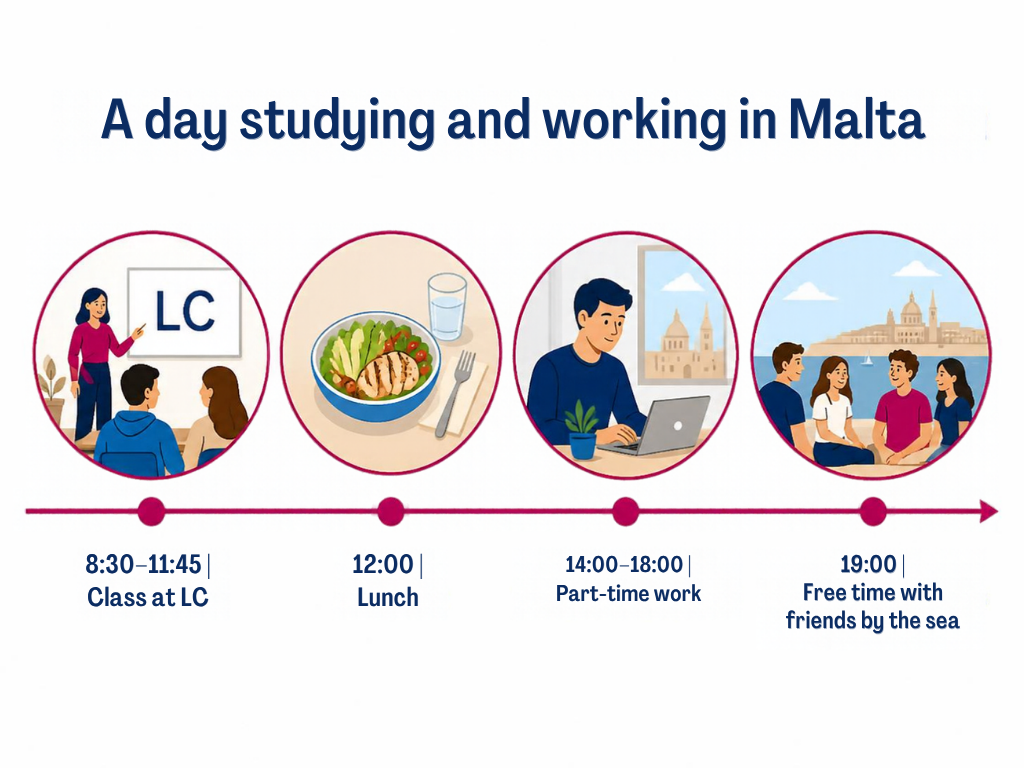
- Morning classes, free afternoons. General English 20 runs from 8:30 to 11:45, so your afternoons and evenings are free for a part-time job.
- Long stays with real progress. Our Long-Term Study programme includes progress tests every four weeks, so you keep moving up while you work.
- Already working in Malta? Our Evening English classes run twice a week, for 1.5 hours each time, so you can study after work.
- Get ready for interviews. With One-to-One lessons, you can practise job interviews, your CV and workplace English with a teacher.
- A great location. Our school is at First Door, 128 Triq Is-Sirk, Swieqi SWQ 3210, a short walk from St Julian’s and our LC School Residence.
Ready to plan your stay?
Studying and working in Malta is a great way to learn English, live like a local and grow as a person. Want to see the cost of your course and accommodation? Use Build Your Experience to build your stay and see the total price. Not sure when to come? Read our guide to the best time to study English in Malta, or compare options in our guide to the best English course in Malta.
Have questions about your situation? Message us on WhatsApp. Tell us your nationality, your plans and how long you want to stay, and we will help you understand your options.
Frequently asked questions
Can I study and work in Malta at the same time?
Yes, in many cases. EU students can work freely. Non-EU students on courses longer than 90 days can usually work up to 20 hours a week after their first three months, with an employment licence from Jobsplus.
How many hours can a student work in Malta?
Non-EU students can work a maximum of 20 hours a week. EU students do not have this limit, but school should still come first.
What is the minimum wage in Malta in 2026?
It is €229.44 a week for full-time workers aged 18 and over, which is about €994 a month, or about €5.74 an hour, before deductions.
Can I work in Malta on a tourist visa?
No. To work in Malta you need the right permit or residence status. Working without it can cause serious problems with your stay.
Does Language Connect find jobs for students?
We are a language school, not a job agency. But we help you get ready: better English, interview practice and a class timetable that leaves time for work.
Do I need perfect English to find a job in Malta?
No. Many students start working with a good intermediate level. The better your English, the more job options you will have, and that is exactly what we help you with.