
Can you learn to speak English in 90 days? The honest answer is: you can change a lot. In three months, you can go from nervous and silent to talking with confidence in real life. You will not be perfect, and that is fine. The goal is to speak, not to be perfect.
In this guide, we share a simple 90-day plan, the daily habits that really work, the mistakes that slow people down, and the fastest way to speak English in 90 days.
What is realistic in 90 days?
Cambridge English says it takes about 200 hours of guided learning to move up one level of the Common European Framework (CEFR). Guided learning means lessons plus study with a teacher’s help. So the number of hours you put in really matters.
Here is what is realistic in three months:
- If you are a beginner: you can learn the basics and have simple conversations about yourself, your day and your plans.
- If you are at an intermediate level: you can feel much more confident in everyday situations, and many learners move up one level.
- If you are already advanced: you can speak more naturally, understand more, and sound more like yourself in English.
The math is simple. If you study for about two hours a day, you get around 180 hours in 90 days. If you take a full-time English course and also use English in daily life, you can get much more.
Your 90-day plan
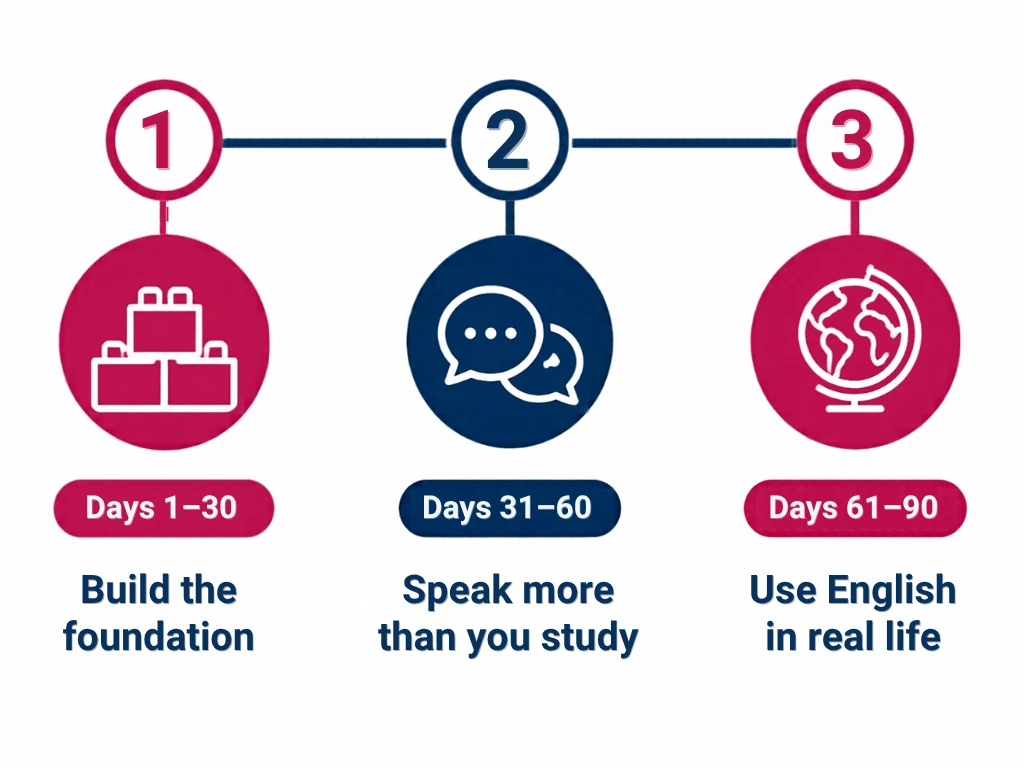
Days 1 to 30: build the base
- Learn useful phrases, not only single words. For example, learn “Could I have…” or “What do you think about…” and use them every day.
- Listen every day. Twenty minutes of podcasts, series or songs in English is enough to start.
- Speak from day one. Even five minutes a day, out loud. Talk to yourself, describe what you see, or read a short text aloud.
- Find your level. Take a placement test, so you know where you are and what to work on.
Days 31 to 60: speak more than you study
- Have real conversations. Join a conversation group, a language exchange or a class where you speak a lot.
- Think in English. Describe your day in your head in English while you walk or cook.
- Copy native speakers. Repeat short parts of videos and try to copy the rhythm and sounds. This is called shadowing.
- Make mistakes on purpose. Every mistake is a step forward. People who are afraid of mistakes speak less, so they learn less.
Days 61 to 90: use English in real life
- Do real things in English. Order food, ask for directions, make a phone call, or give a short presentation.
- Watch without subtitles, or with English subtitles only.
- Tell longer stories. Talk about your weekend, a film or a plan for two or three minutes without stopping.
- Check your progress. Take a level test again and see how far you have come.
8 daily habits that make a big difference
- Speak a little every day, even when you feel tired.
- Learn 10 new words or phrases a day and use them in a sentence.
- Change your phone and apps to English.
- Listen while you do other things, like walking, cooking or taking the bus.
- Write three sentences a day about your day.
- Record yourself once a week and listen to how you improve.
- Ask for feedback from a teacher or a friend.
- Celebrate small wins. Understanding a joke or a song is real progress.
Mistakes that slow you down
- Only studying grammar. Grammar helps, but you learn to speak by speaking.
- Waiting to be perfect. Nobody speaks perfectly. Start now.
- Translating every word. Try to understand the main idea instead.
- Studying alone all the time. Apps are useful, but they cannot replace real conversations.
- Not getting feedback. Without someone to correct you, the same mistakes keep coming back.
The fastest way: live in English
The quickest way to speak English in 90 days is to live in English. When you study abroad, you do not only learn in class. You use English at the supermarket, on the bus, with new friends and at every activity. Your learning hours grow every day without you noticing.
Malta is a great place to do this. English is an official language, the island is small and easy to explore, and you meet people from all over the world. Good to know: if you come from a visa-exempt country, a course of 90 days or less usually does not need a visa. Read our visa guide for studying English in Malta to check your case.
This is how 90 days with Language Connect can look:
- A clear start. You take an online placement test before you arrive, and your teacher checks your level in your first classes.
- Lots of speaking time. General English 20 gives you 20 lessons a week, with no more than 12 students per class and usually 8 or 9.
- More hours if you want them. Intensive English 30 adds an afternoon session focused on speaking: discussions, debates and presentations.
- Three progress checks. In 90 days, you take a progress test about every four weeks, so you can move up as soon as you are ready.
- Help with your weak points. One-to-One lessons focus only on what you need.
- English after class too. Activities and trips help you use English in real situations, every week.

Start your 90 days
Ninety days can change the way you speak English, and the way you feel about it. Plan your course, dates and accommodation with Build Your Experience, and find the best time to study English in Malta for you. Still choosing? Compare options in our guide to the best English course in Malta, or message us on WhatsApp. Our school is at First Door, 128 Triq Is-Sirk, Swieqi SWQ 3210.
Frequently asked questions
Can I become fluent in English in 90 days?
If you start from zero, probably not fully fluent. But you can speak with much more confidence. If you already have a good base, 90 days of full-time study can make a very big difference.
How many hours a day should I study to speak English in 90 days?
Try for at least two hours a day, including speaking practice. A full-time course plus daily life in English gives you even more.
Can I learn to speak English only with apps?
Apps are good for vocabulary and listening, but speaking needs real conversations and feedback from a teacher.
Is it better to study English abroad?
For speaking, yes. Living in English means you practise all day, not only in class, so you improve much faster.
How do I know if I am improving?
Take a level test at the start and again later. At Language Connect, progress tests happen about every four weeks.